
This past summer, one of our cottage projects was building a deck skirt – it required planning and DIY execution resulting in a very successful outcome.
Read more: What’s Under the Deck?Our summer cottage has a large raised deck overlooking the lake. It’s a lovely place to sit and watch the waves or gaze at the moon and stars at night. A couple of years ago one of our projects was to paint the deck yellow as we particularly disliked the original green, (see below) and on warm sunny afternoons when walking barefoot, it was way too hot – so hot that Max the Doodle would often be seen doing a tap dance.

This past summer we built a skirt around the deck. Admittedly, this is not the most complex job, but if you have never done it before and you’re not a professional, it is one of those projects that can enhance or negatively impact the curb appeal or in this case the lake appeal of your cottage.

Why Build a Skirt?
This deck is raised about 5 feet above the ground, and while it provides a picturesque setting, the sheer height of the deck exposes an underbelly of support logs, stored equipment and toys – it’s like an unkept pantry with no doors and takes away from the overall appearance.
This DIY made a lot of sense for us, as it would tidy up the frontal look to the property and would add to the overall aesthetic appeal. Not only did we know that we would enjoy the task (with a few very minor skirmishes) and we could do it well, we also knew we could complete the entire job on our own.
My father use to call these “fun jobs” and further would go on to say – “you will laugh all the way through it” – makes me smile because in those days when I heard this, I didn’t laugh and wanted to run for the hills.
Planning is Everything
My husband and I are not professional crafts people, but with planning and retirement time on our side we can approach and complete most DYI’s with professional outcome. The complexity of our projects can usually be measured by the number of trips to the hardware store, but this time around we would be on our island, making any unplanned trips a waste of a half day – we therefore needed to step up all aspects of our game and as the old saying goes, measure 3 times and cut once.
Before closing the cottage the previous fall, we made sketches, took measurements of each of the deck sections and further took numerous pictures in case our age started to set in. We also spent a lot of time looking at other cottage skirts in the area to understand what worked and what didn’t.
Over the winter we had time to ponder and plan; how we wanted it to look, what material to use, how we would transport the material to the cottage and what tools we would need – we must have watched 30 YOUTUBE videos and visited numerous Big Box stores.
Fortunately our ideas were nicely aligned and here’s what we decided:
- Pressure treated traditional cedar fence board would give a nice look and not require painting
- The entire front facing the lake would be vertical fence boards with a side door to access storage
- We wanted the skirt to be flush with the top vertical edge of the deck and the side column (legs)
Material
- Pressure treated cedar fence boards (skirt boards) – 1 inch thick by 6 inch wide by 8 foot long (1”x6”x8’)
- Each fence board would be cut to length providing 2 vertical skirt boards
- Cedar fence board would also be used to build the side door
- Pressure treated board would be used to hang the skirt boards on (backing)
- 2 inch by 4 inch x 10 foot (2”x4”x10’) – 2 for each section
- Pressure treated board would be used for the door frame – 2 inch x 6 inch x 10 foot (2”x6”x10’)
- Hanger joists (brackets) to secure the skirt board backing
- 2 inch x 6 inch hanger joists – 4 for each section
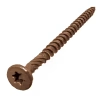
- About 100 2.5 inch bronze coated deck screws to secure the hanger joist and skirt boards
- About 12 3.5 inch bronze coated deck screws to secure the framing for the side door
- Hinges and locking latch as a package for the side door



Tools We Used
- Circular saw for cutting the boards to size – you could get away with an old fashioned hand saw, but if you don’t need to….why?
- Dewalt ¼ inch cordless impact driver for the screws with a square #2 bit (extra bits too) – this is the standard for deck screw bits. You need this or a like tool for this job.
- Levels – to stay true with the boards vertically and to stay true with the backing boards in the brackets. I used a 2 foot and a 6 inch level.
- Measuring tape
- Pencil
- Spacer to set the vertical skirt boards equal distance apart. I used an eighth of an inch thick strip wood board which doubled as a straight edge for pencil outlined saw cut lines.


Method
We divided the job into sections – each gap between the column legs was a section, the side door was another section and the ramp gaps were the last section for a total of 5 sections. Each section took a little over a half day and we worked on one section per day. We weren’t tied to a deadline, took a couple of days off and had some weather but we completed the project in about 10 days.
The Front of the Deck (For Each of the 4 Gaps)
Step 1: Hang the brackets – Four brackets for each gap, 2 on each side spaced about 1 foot from the top and 1 foot from the bottom. Screw the brackets into the columns – the back of the bracket first and the front only after the 2”x4” has been fit in – 2 brackets on each column to hold each end of 2”x4” boards
- Each bracket needed to be indented about 1 inch inside the column in order that the outer hanging skirt board (which is 1 inch thick) would be flush with the top of the deck and the columns. In this case the deck legs were perfectly right angled with the deck top, which made this a lot easier – we also used a small level to ensure the bracket was vertically level.
- The brackets on the adjacent column also needed to be level with the opposite brackets across the opening in order that the hanging 2”x4” boards would be level – this did not need to be absolutely perfect but needed to be close, otherwise the vertical 2”x4” could be uneven and the hanging deck boards would not all line up. We used the 2”x4” laid across the brackets to line this up.
- Using the brackets was a good idea as they also helped to straighten the 2”x4” backing as these are not always “true” and the warp would cause the skirt boards to hang differently.

Step 2: Cut to length and hang the 2”x4” (s) across to each bracket and screw the front end of the bracket into the board and the column to secure.


Step 3: Cut the cedar skirt board to size and screw into the top back board (2”x4”) and bottom board (2”x4”) – 2 screws for each back board top and bottom.
- Skirt board size should be based on a snug fitting to the top of the deck to a quarter inch from the ground.
- Use the strip wood (1/8 of an inch thick) to maintain an equal gap between the skirt boards and the leg columns.
- Periodically use the level to ensure the vertical skirt boards are maintaining a vertically level and adjust if necessary.
- The skirt boards rarely fit perfectly across the opening without the last board needing to be cut vertically – cutting vertically was not difficult with the circular saw, especially since the boards were relatively short.
- The leftover cut skirt boards ranged from 1 to 2 feet long which we later used for the gaps along the ramp – see ramp pictures.
- >>>>>Repeat the above for each gap.


The Side Door
Step #1: Build a second post to have a complete door frame. This required a bit of thought, but was accomplished by hanging two 2”x6” boards cut to length, with one board attached to the inside of the deck frame, and the second board attached to the outside of the first board running up to the deck frame – it created a perfect post like the existing posts.
- 1 2”x6” would hang along the inside of the deck frame (a side running 2”x12” board) to the ground and secured with the 3.5 inch screws into the 2”x12” along the inside – about 8 inches of existing deck frame giving plenty of space for a firm attachment.
- The second 2”x6” would hang along the outside and attached to the new 2”x6” using 3.5 inch screws up to the deck frame from the ground, basically creating an additional post to act as the frame.
- Key was to make sure that the new post was right angled to the deck frame and vertically level.

Step #2: Now I have to say that we cheated when building the door but it worked for us and looks fine. Fortunately, the existing lefthand post was at a perfect right angle (perpendicular) to the frame running across the deck top as all posts were for the entire deck – this deck had been built by real pros.
- The door was built using the same skirt boards cut to length allowing for clearance to open along uneven ground and 1/4 inch clearance along the top.
- Using two skirt boards as the door frame backing and cut to length to the width of the door opening, we took another deck board and attached it vertically along the front left side of the two horizontal boards – the horizontal boards would each measure an equal distance front the top or bottom of the vertical board.
- Hinges would be screwed into the vertical board, one each at the center of each horizontal board.
- To steady the entire piece, a skirt board would be temporarily attached to the front far right side of the horizontal skirt boards frame creating a door skeleton.
- The skeleton was then attached to the left side post by the hinges using the gaps at the top and bottom of the vertical board as a centering guide.
- From there, left to right attach cut to length skirt boards using the spacer to keep equal distance apart and the level to ensure we remained vertically true.
- Finally, we took the temporary board off and attached the last vertical board – it needed to be cut lengthwise to fit.
- Attach the locking mechanism at the top where the horizontal board covers the vertical board and attach the corresponding lock mechanism to the door frame pole ensuring the lock works.


The Ramp Gaps (3 Gaps)
There were three ramp gaps that we felt had to be filled in, otherwise the skirting would look incomplete. The process was similar to the front facing gaps except the gaps were vertically much smaller and therefore did not require 2 horizontal backing boards (only 1). For the most part we were able to use the skirt board cuttings that were left over from the front.
- 2 brackets (one on each side) to hang the single 2”x4” backing board.
- As you can see by the picture this is a small space and got smaller as you went left to right.
- It felt like we were playing “Twister” which is tough for seniors and left us sore all over!


Well, that was it. The skirt was complete and we are quite satisfied. The key to this project and not unlike any project was all the planning we did. I also think it helps to appreciate your abilities and not be bashful about asking for advice and talking to lots of people for ideas. By the time we started the work, we knew exactly what had to be done, it was like clock work.


Like any project, we always do a recap, and it’s funny how we see faults that perhaps nobody would notice. One key thing we missed was that the front top frame board on the deck was not even across each gap – it was not horizontally straight across the entire front of the deck. The result is that if you look closely, the top of the skirt across multiple sections is not even. It’s a little thing but noticeable. In retrospect we could have added a narrow board in those sections that were shorter to shore things up across the entire front. Oh well…..I guarantee that we are not tearing it apart but will keep it in mind if there is ever a next time.

Thanks for stopping in at Everyday Lillie. Please have a look around as much as you like. If you enjoyed the visit, please feel free to follow, share, comment or like. Please drop in again soon!
Follow Everyday Lillie on WordPress.com
Congratulations! An impressive DIY project.
Amazing! Love the new look.
Hard work, but end result is beautiful. Love photo of Max, I’m sure that’s how you felt too.
You’ve got a future in writing DIY manuals.
Great job. There is such a satisfaction in starting and completing something like this. It will also help keep out critters and does indeed look very pro. I see the unven horitzonal boards but it’s not a huge deal.
Nice work!
I love the new look! The deck looks beautiful. The picture of Max was fun!
It’s lovely but when can I visit? Seriously, great job.
Just curious if you know of any summer Airbnb rentals on that beautiful lake? Where exactly do you live?